FOR THE HOUSES, FOR THE PLANET, FOR EVERYTHING
A sort of political synthesis of the Lisbon meeting
November 25
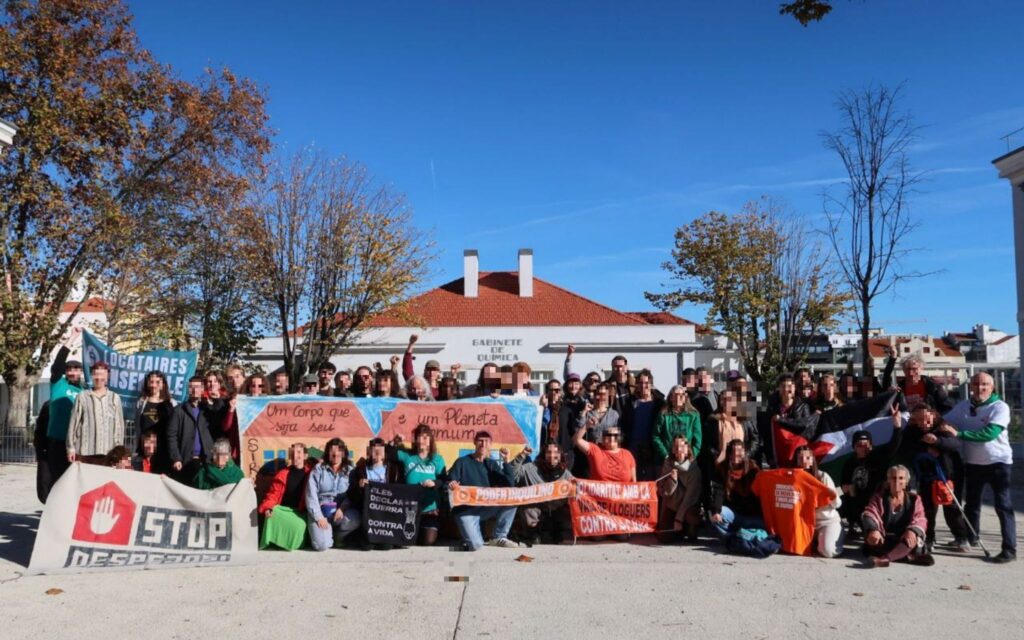
For the first time we decided to organise the EAC meeting side by side with the climate justice movement. Having started this journey in June, this was a modest gathering between movements, bringing together organisations that work on the right to housing, organise people who lose their homes due to the climate crisis, fight against capitalism and for alternatives, work against touristification and aviation, and for cities shaped by and for people.
We were a constellation of collectives, associations, cooperatives and unions that come together to challenge, from the bottom up, the system of death and alienation that wants us to be exploited, starting with our need for a home to live in and a planet on which to live.
We are those who feel the urgency to bring about and build class solidarity, to affirm it and practise it above property rights.
We are those who put our bodies on the line to defend people from eviction and destructive projects and infrastructures to run.
We are those who occupy the homes left empty by greedy speculators.
We are those who live on the streets because we have no roof over our heads.
We are those who decided to live in a different way. We are those who knock on doors to organise tenants against rents that are nothing more than theft.
We are those who occupy the streets, stations and airports to save the people and the planet from climate collapse, so no one is left behind.
We are the ones whose homes were destroyed by the floods.
We are those who organise rent strikes against the monsters of finance.
We are the ones who refuse to resign ourselves to seeing our cities privatised and polluted by the tourism industry.
We are the ones who fight for the redistribution of wealth, against big financial funds and wealth hoarders.
We are the ones who fight against energy poverty and for the right to live in healthy and dignified homes.
We are the ones who animate social spaces where profit has no place, where we organise, conspire and live a beautiful life.
We are this, we are also other things, we will be everything.
We are these, and we unite beyond and against borders, starting from our homes, our neighbourhoods, our cities. For decades now, our territories have been sold off and exploited through policies promoted by governments in the pay of financial capital and its neoliberal ideology. Through accumulation by dispossession, they produce territories based on exploitation and inequality, bringing the climate and the planet to collapse. Territories that are literally becoming more unliveable every day, governed through systems of control and devices of fear. But we are here, and we are not alone. We are here to reject wars, first and foremost those between the poor, artfully promoted by the wealthy elites. We are here to break down individualism by deciding to stand and fight together. We are here to prevent the worst scenarios of the climate crisis. We are here, strong because of our experience, our determination and our commitment, but above all thanks to our deep roots in the local communities and therefore we know the territory better than our counterparts. We are here, and fortunately we are not alone.
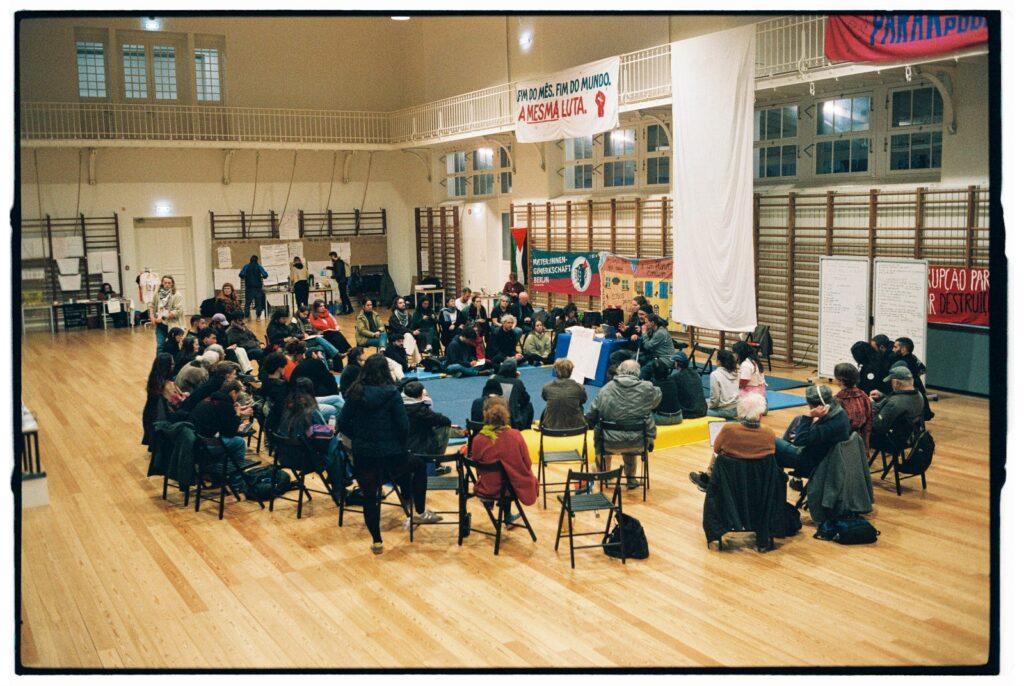
Together we can and want to build popular power capable of changing the status quo. To bring down the capitalist system and not the territories in which we live, we need to create even closer and more diverse alliances. Winning houses for all means winning a liveable planet for all. Winning climate justice means everyone having a house where they can be safe and face climate catastrophes. Being alive in 2025 means that we have a historical responsibility to actually have plans to win while we are alive. It’s not easy nor certain, but it’s our best option in front of us.
We started this gathering with understanding the different theories of change in the room and the different strategies present. The great diversity that sets us apart is both a strength and a weakness. There are disparities that depend on individual local contexts and also on the subjectivities that are organised. Being homeless in Lisbon or a tenant in Berlin means being part of the same struggle, but the two daily lives are very different. This is why we need to create more effective mechanisms for sharing knowledge, tactics and strategies, but also tools for sharing resources that can help regions and groups that are more or less disadvantaged.
On the first day we also realised that our strategies are not compatible with living in a climate crisis. Time is not our ally. Every day we have to deal with the slowness of our organisational and mobilisation processes and the speed of capital’s attacks on people’s lives and the planet. On the one hand, the deadlines that scientists set as essential to avoid collapse cannot be ignored and need to be acted on. On the other hand, we face the difficulty of meeting them within the timeframe of our struggle and without becoming overcome by anxiety and resignation. There is also a tension between the urgency in front of us and the time that it takes to organise the masses and to build trust.
We need spaces, moments and deep political reflection that allow us to propose a concrete alternative and ways to fight back and stop the death we see before our eyes every day. Luckily our struggle has not started today. We are part of a long term fight of several centuries, facing now a decisive moment for all humanity.
There was an unavoidable contradiction within this conference. Throughout the sessions, most housing rights collectives and some of the climate justice organisations, a clear majority, framed their goals around obtaining better housing conditions for the working class via organising and advocacy within the working class itself. In other words, the ambition presented here was to create better conditions for the working class to reproduce itself under an economic system that undermines its own reproduction. This is placing the goal of achieving better housing conditions as an end in itself and the working class organisation created along the way as a useful byproduct for an undefined future of revolution to be done by others at another time. This clashes with the correct and widely shared analysis among participants that identifies capitalism as the systemic root of the housing crisis and the source of the climate crisis as an imminent existential threat. On the one hand, we acknowledge the systemic roots of these issues; on the other, the task of organising the revolution to end those causes is relegated to a secondary objective. To end homelessness and energy poverty and achieve dignified housing for all, we must dismantle capitalism. Yet, we end up organising ourselves to help the State manage the crisis of capitalism, instead of placing at the center of our objectives building a movement capable of changing the system, with the climate and housing crisis as organising forces. This contradiction was visible sometimes, but we weren’t able to address it.
We thus navigate through the analysis of our limitations, habits, internal conformisms, and organisational barriers that prevent us from winning, and what we need to transform in order to win. Inspired by small (big) stories of victories and strategic tools, we mapped out the power of our enemy and how they organise themselves, so that we can begin to draw up our own plan: a path of offensive struggle, not just defensive/resistance.
We need to make a further effort to achieve coordinated collective mobilisation that reflects an equally strong grassroots organisation. A form of mobilisation capable of blocking the deadly flows of financial-logistical-war capital and its centres of power, as the rent strike that some of us are carrying out does. Strengthen communities in struggle and converge to materialise the intersectionality between climate, housing and labour into coordinated direct action.
We explored how floods, fires, and heatwaves affect access to housing, displace people, and cause forced migration. We reflected on how to communicate with our people in a hybrid and effective way, so that we can convey our needs, our demands and our complex visions in a simple manner.
We were also aware that although we were two movements, we needed to work with many others. We reflected on when and in what situations it would be strategic to form alliances with trade unions, anti-racist struggles, feminist struggles and migrant struggles. Alliances in which individual struggles are not diluted but gain strength and reinforce each other. This work needs to be done in each territory and at a transnational level.
By the end of the four days, we arrived at strategic challenges to bring back to our collectives, with new tasks and with guiding lines for the Housing Action Days. Let’s commit to organising them in the best possible way.
The road ahead will be winding and full of difficulties. But it will be the road we have chosen as individuals and as groups, as neighbourhoods, cities and peoples in struggle. There will be a lot of anger to organise, many injustices to face, immense desires to fulfil. But we know that we will be there, and that we will be side by side. And that is our strength.